Permanent Makeup Removal
A practical guide to permanent makeup removal across brows, eyeliner, and lip blush. Compare laser and saline methods, understand oxidation risk, and learn when correction beats full removal.
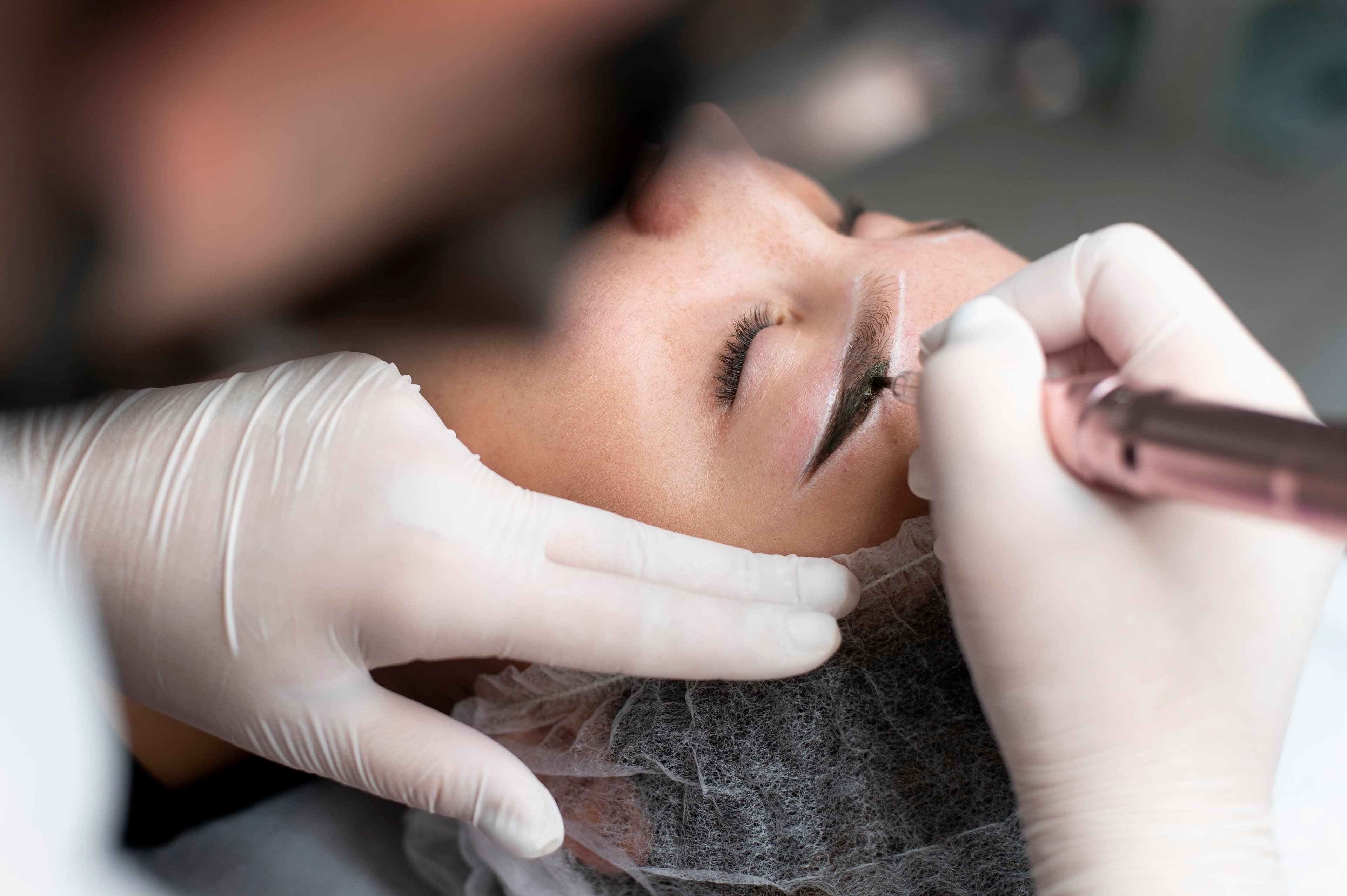
Permanent makeup can usually be removed or corrected, but cosmetic tattoos do not behave like body tattoos. The pigments are different. The skin is thinner. The stakes for color shifts are higher because the work is on your face. And the right method often depends less on price or convenience. It depends more on what pigment was used and what area of the face it sits on. This page covers how permanent makeup removal works across the three most common areas. Brows, lip blush, and eyeliner. It explains where laser and saline each fit. It covers why certain pigments darken instead of fading. And it covers when correction is a smarter endpoint than chasing total removal.
How Permanent Makeup Removal Works
Permanent makeup (PMU) uses pigments deposited into the upper dermis, similar to a tattoo but shallower and in smaller amounts. Common PMU pigments include iron oxide, titanium dioxide, carbon-based dyes, and organic colorants. The specific mix matters because different pigments behave differently during removal.
There are three realistic paths:
- Laser removal uses specific wavelengths to fragment pigment particles so the body can clear them through the lymphatic system.
- Saline removal uses a sterile hypertonic solution implanted into the PMU with a tattoo machine or manual tool. Salt draws pigment upward through osmosis, and pigment leaves as the area scabs and heals.
- Correction reshapes, re-colors, or camouflages existing PMU with complementary pigment instead of removing it.
Glycolic acid removal is a less common chemical method, sometimes marketed under brand names like PhiRemoval. Providers using it position it as gentler than laser for facial skin, but industry opinions are split. Critics note that acid deep enough to reach pigment also causes significant skin trauma and scarring risk. If you are considering it, ask the technician specifically about their scarring rate and aftercare protocol before booking.
The right path depends on several things. Pigment chemistry. How saturated the work is. What area of the face it sits on. And whether your goal is a clean slate or better-looking PMU.
Why Permanent Makeup Removal Is Different
PMU removal has its own logic that does not carry over from body tattoo removal.
Pigment chemistry changes the rules. Iron oxide, the most common PMU base, can reduce under laser energy and shift from red or brown to gray or black. Titanium dioxide, often used for opacity or light shades, can react to laser and turn gray-black almost instantly. This is why patch tests are standard for PMU laser work and not optional.
Location raises the stakes. Body tattoos can be partially faded and hidden. A color shift on brows, lip line, or eyeliner cannot be hidden. Mistakes show every day until they are corrected.
The skin is thinner. Brow, eyelid, and lip skin heals differently from body skin. Scarring risk, pigment migration, and healing time all shift compared to a standard body tattoo.
The goal is often not total removal. Many people want correction, not erasure. Getting 60 to 80% faded and then adding new PMU over a clean base often gives a better result than chasing 100% clearance.
Laser Removal for Permanent Makeup
Laser is the most familiar method and, for the right pigment, it works. Picosecond and Q-switched Nd:YAG lasers fragment pigment into particles the body can clear.
Laser works well for dark, iron-oxide based pigments in brows where the technician used a known, documented ink. It is also a good fit when the goal is heavy lightening before rebooking new PMU.
Laser is risky for pigments with high titanium dioxide content. It is risky for warm-toned pigments (orange, red, light brown) that can shift color before fading. And it is risky for lip blush work, where pigment composition is often unpredictable. A patch test six to eight weeks before full treatment is the only reliable way to check how your specific PMU reacts.
Sessions are typically spaced six to eight weeks apart, and most people need three to eight sessions depending on saturation and pigment response.
Saline Removal for Permanent Makeup
Saline removal implants a hypertonic salt solution into the existing PMU and lifts pigment through osmosis as the area heals and scabs.
Saline works well for warm or light pigments where laser oxidation is a real concern. It works for titanium dioxide or white-base pigments that laser cannot safely treat. It works for shallow PMU that responds to surface-level lifting. And it fits patients who want a non-laser option for any reason.
Saline is limited for deeper, denser PMU that behaves more like a body tattoo. It is also limited for patients who cannot tolerate visible scabbing on the face for 10 to 14 days per session.
Sessions are spaced six to eight weeks apart, and three to six sessions is a normal range. Done well, saline has a lower color-shift risk than laser. Done poorly, it can cause scarring, patchy healing, or texture changes. Technician skill matters more than the saline brand used.
Laser vs Saline for Permanent Makeup Removal
There is no universal winner. The choice depends on pigment, area, and goals.
Choose laser when PMU is dark and iron-oxide based. Choose it when you want fewer sessions of visible facial scabbing. Choose it when a patch test shows clean lightening without oxidation.
Choose saline when PMU is warm-toned, white-based, or contains titanium dioxide. Choose it when laser patch tests have caused any color concern. Choose it for lip blush, where pigment unpredictability makes laser risky. And choose it when you would rather manage scabbing than risk a color shift on the face.
Consider both methods in sequence when PMU is saturated enough that one alone stalls, or when partial removal has left a stubborn tone.
A good PMU removal specialist tells you honestly which method fits. A technician who offers only one method and insists it is always best is a signal to get a second opinion.
Permanent Makeup Removal by Area
Eyebrow Tattoo and Microblading Removal
Brows are the most common PMU removal request and the most flexible in terms of method. Microblading (hand tool, hair-stroke pattern) often removes more easily than machine-done ombre or powder brows, because the pigment sits shallower.
Both laser and saline work on brows, depending on pigment. Laser tends to be faster for saturated, dark work. Saline tends to be safer for warm-toned or titanium-heavy work. For full brow-specific detail, see the microblading removal page.
Lip Blush Removal
Lip blush is the trickiest PMU to remove. Pigment formulas vary widely, lip tissue heals differently from facial skin, and color shifts are highly visible.
Saline removal is often the safer choice for lip blush because laser energy on lip pigments has a higher risk of unpredictable color reactions. That said, saline on lips causes significant swelling and 10 to 14 days of visible healing per session, which some patients find hard to commit to.
Correction is often the smarter endpoint for lip blush. A skilled artist can neutralize or adjust color with complementary pigment, which is frequently cheaper and faster than full removal.
Eyeliner Tattoo Removal
Eyeliner removal is the most cautious of the three. Proximity to the eye means the margin for error is very small.
Most experienced practitioners prefer saline for eyeliner, because laser energy near the eye area carries extra risk even with proper eye shields. Saline is slower but keeps the treatment superficial.
Eyeliner removal must be done by a practitioner with specific eyelid experience. A technician who does body tattoos and mentions eyeliner as an afterthought is the wrong fit for this.
Permanent Makeup Correction vs Complete Removal
Correction is underused and often better than full removal.
Correction makes sense when shape is wrong but color is usable. It works when color has shifted warm and can be neutralized with complementary pigment. It works when PMU has migrated slightly but the base is intact. And it works when you want PMU, just not this PMU.
Complete removal makes sense when you do not want any PMU going forward. It fits when pigment has shifted to cool gray or blue tones that camouflage poorly. It fits when work is too saturated to correct cleanly. And it fits when previous correction attempts have made the problem worse.
Many people start out wanting full removal and realize partway through that 70% faded plus skilled new PMU gives them a better result than chasing 100% clearance. That is a legitimate outcome.
Risks of Permanent Makeup Removal
PMU removal risk falls into three main categories.
Oxidation and color shift is the biggest laser-specific risk. Iron oxide and titanium dioxide can react to laser energy by darkening rather than fading, turning pigment gray, black, or greenish instantly. A patch test is the only reliable way to rule this out before full treatment.
Scarring and skin texture change is usually low when the method matches the pigment and the technician is experienced. Aggressive laser settings, too-close session spacing, or at-home attempts raise scarring risk sharply. Facial skin is more prone to visible texture change than body skin.
Pigment migration or patchy healing can occur with saline if the solution is applied unevenly or if scabs are picked during healing. Migration is rare when aftercare is followed.
Temporary swelling, redness, and scabbing are normal for both methods and typically resolve in 10 to 14 days per session. Contact your technician for signs of infection. Also contact them for pain beyond 48 hours or any color change that spreads beyond the treated area.
What to Expect: Sessions, Cost, and Healing
Sessions for both laser and saline are typically spaced six to eight weeks apart. Full removal usually takes three to eight sessions total, depending on the area, saturation, and pigment type.
Costs vary by region, area, and method. For most PMU removal work, per-session pricing is similar across methods, typically in the $150 to $400 range, with lip and eyeliner work sometimes priced higher due to technique complexity. Total cost for meaningful fading or full removal usually runs in the low four figures. Correction-only work is often cheaper than full removal.
Healing per session includes mild swelling, redness, and a visible scab that resolves in 10 to 14 days. Aftercare instructions vary slightly by method, but the universal rules are the same. Keep the area clean, do not pick the scab, avoid sun exposure, and avoid makeup on the treated area until healing is complete.
- Saline Tattoo Removal. Outcomes, healing, and when saline fits cosmetic ink cases.
- Non-Laser Tattoo Removal. Method category: saline, chemical extraction, dermabrasion-based.
- Saline vs Laser. Two mechanisms compared on color, scarring risk, and use cases.
- inkOUT. Non-laser specialist across five markets.