Tattoo Removal Scarring Concerns
A practical risk-assessment guide to tattoo removal scarring. Learn which methods, providers, and skin types carry lower risk, and how to reduce scarring likelihood before and during treatment.
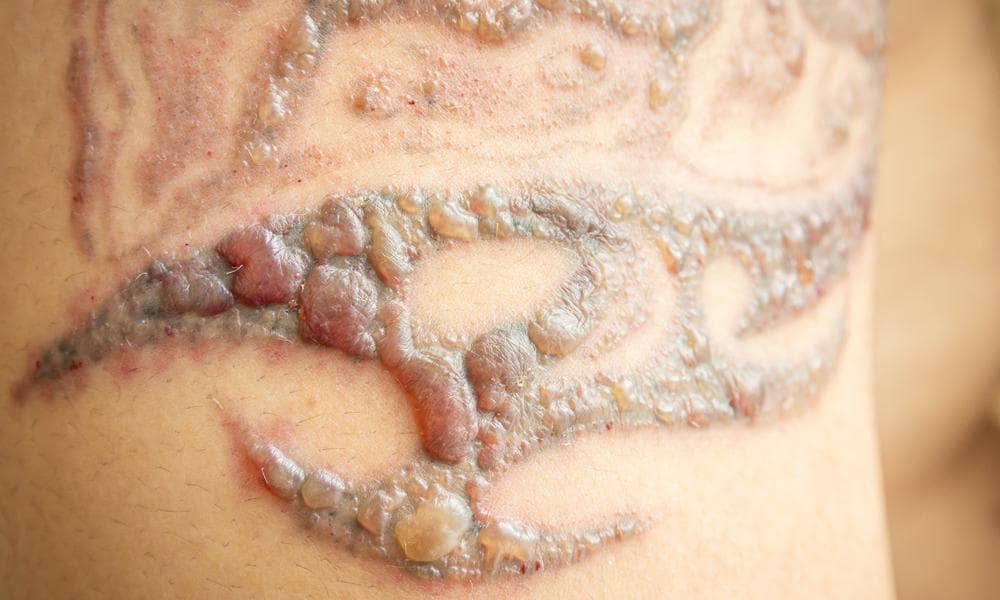
Tattoo removal scarring is real. It is much less common than most people assume. A large peer-reviewed study of 1,041 laser tattoo removal patients found hypertrophic scarring in 0.28% of cases. The same study found zero cases of keloid scarring. In other words, fewer than 1 in 300 patients developed a hypertrophic scar. None in that study developed keloids. That is the baseline to measure your personal risk against. What raises scarring risk above that baseline is more predictable than most clinics suggest. Four things drive it: the wrong method for your case, the wrong settings for your skin, an inexperienced provider, and aftercare failures. This page helps you filter those risks by method, skin type, provider profile, and behavior. The goal is to help you decide which tattoo removal path is safer for your specific situation.
Does Tattoo Removal Cause Scarring?
Rarely, when done well. The most-cited data comes from a 2016 retrospective review. Researchers analyzed 1,041 laser tattoo removal patients. The study was published in the Journal of Clinical and Aesthetic Dermatology. The study reported 0.28% hypertrophic scarring and 0.00% keloid incidence. All patients received at least five treatment sessions with a Q-switched Nd:YAG laser under standard protocols.
A separate prospective study reported total adverse effect incidence at 6.2%. Hyperpigmentation was the most common finding, at 4.8%. Hyperpigmentation is skin darkening, not true scarring. Most post-treatment changes that patients call "scars" are actually pigment changes or textural changes. These resolve over months.
What matters for you is context. The quoted tattoo removal scarring risk numbers apply only under specific conditions: accurate protocol-based settings, appropriate laser, and experienced providers. Clinics running aggressive settings produce scarring at much higher rates. So do clinics treating without patch tests, spacing sessions too close together, or treating darker skin with inappropriate wavelengths. Your personal risk depends on matching your case to the right setup.
Can Laser Tattoo Removal Leave Scars?
Yes, but the rate is low when treatment is done correctly. The FDA lists scarring as a possible risk of laser tattoo removal. Other listed risks include hypopigmentation, infection, pinpoint bleeding, and temporary soreness. At the same time, the FDA confirms that laser tattoo removal is safe and effective when performed by a trained health care professional.
The real question is not whether laser can cause scars. It is what raises the risk above the 0.28% baseline. Five factors consistently show up in the clinical literature and in provider practice:
- Laser fluence too high for the skin type
- Pulse duration too long for the target tissue (older, non-Q-switched lasers)
- Session spacing too close together
- Aftercare failures (picked scabs, sun exposure, infection)
- Patient factors (keloid history, recent tanning, medications affecting healing)
Match the method, laser, fluence, and schedule to your case, and the number stays near 0.28%. Miss on one or more of those, and the rate climbs.
Normal Healing vs True Scarring
Most post-removal skin changes are not scars. They are normal healing. Confusing the two causes unnecessary panic mid-treatment.
Normal and expected after laser sessions:
- Redness, swelling, and pinpoint bleeding (first 24-72 hours)
- Blistering (first 1-3 days)
- Scabbing (days 3-10)
- Temporary lightening or darkening in the treated area (weeks 1-12)
- Faint ghost outline where the tattoo was, often textural rather than pigmented (weeks 4-24)
Not normal, contact the provider:
- Raised, thickened skin forming a firm ridge or bump
- Indented, pitted skin that persists past three months
- Skin that looks significantly different from the surrounding tissue six or more months after treatment
- Pigment change that spreads beyond the original tattoo outline
- Any sign of infection (spreading redness, pus, fever, pain worsening after 48 hours)
Hypertrophic scars are raised and firm. Keloid scars extend beyond the original treatment boundary. Both are true scarring and need medical evaluation. Textural ghost outlines usually are not true scars and often improve over 12-24 months.
Which Tattoo Removal Methods Have Lower Scarring Risk?
Method-by-method risk filter:
Q-switched Nd:YAG laser (standard of care). Lowest-risk category when used at protocol settings. 0.28% hypertrophic scarring incidence per the 2016 JCAD study. Nanosecond pulse widths (roughly 5-10 ns) deliver energy faster than the thermal relaxation time of tattoo pigment. That limits surrounding tissue damage. This is the reference point against which other methods should be measured.
Picosecond lasers (PicoSure, PicoWay, Enlighten). Lower thermal load than Q-switched due to shorter pulse widths (300-500 picoseconds). Clinical data suggests less blistering and fewer pigmentary changes. It also suggests lower scarring risk than Q-switched Nd:YAG. Best option when available and affordable, especially for darker skin or color work.
Saline removal. Used mostly for PMU (brows, eyeliner, lip blush) and small tattoos. Scarring risk is technician-dependent. It is not inherently lower or higher than laser. Done well, saline has low scar risk. Done poorly, saline can cause patchy healing, uneven texture, and scar-like changes. Not a standard option for body tattoo removal.
Chemical or acid removal (glycolic acid, alkaline solutions). Significantly higher scarring risk than laser. A 2022 retrospective study in the European Journal of Dermatology documented hypertrophic and atrophic scarring from chemical removal methods. Providers marketing these methods as "gentler" often understate the scarring data. Approach with caution.
Dermabrasion, ablative lasers, surgical excision. FDA notes these methods have higher scarring potential than Q-switched laser. They are less commonly used for this reason. Surgical excision has the highest scar certainty. It creates a deliberate surgical wound. It is used only for very small tattoos or when all other options have failed.
Creams and at-home kits. Not FDA-approved for tattoo removal. Can cause skin rashes, burns, or scars. Avoid.
Ranking from lowest to highest scarring risk for most body tattoos: picosecond laser first. Then Q-switched Nd:YAG laser. Then saline (for PMU and small tattoos only). Then chemical removal. Then ablative lasers or dermabrasion. Surgical excision carries the highest risk.
Scarring Risk on Dark Skin
Darker skin carries extra risk not of true scarring but of pigment change. Pigment change is often mistaken for scarring. On Fitzpatrick IV-VI skin, the 2016 JCAD study offers reassuring data. None of the 38 treated patients with Fitzpatrick V or VI skin experienced hypertrophic scars or keloids. That suggests something important. With appropriate settings, darker-skin patients do not have higher true-scarring rates.
What darker skin does face:
- Higher rates of hyperpigmentation (melanin absorbs laser energy and triggers pigment production)
- Higher rates of hypopigmentation when settings are too aggressive
- Higher baseline risk of keloid or hypertrophic scarring for people with a genetic predisposition
- Greater consequences from provider errors because pigment changes are more visible
The mitigation is wavelength and settings, not avoidance of tattoo removal itself. A 1064 nm Nd:YAG laser bypasses most epidermal melanin and is the standard safest choice for dark skin. Lower fluence and longer session spacing (8-12 weeks instead of 6-8) reduce thermal load. A provider experienced with Fitzpatrick IV-VI skin is key.
For full dark-skin-specific risk guidance, see the dark skin tattoo removal page.
Provider Selection for Lower Scarring Risk
The single biggest variable in tattoo removal scarring risk is provider skill, not the specific laser model. Three provider questions predict outcome quality better than any marketing claim.
Who operates the laser? Board-certified dermatologists and physician-supervised clinics with dedicated laser technicians produce lower complication rates. Medspa chains with rotating staff produce higher rates. A dermatology practice with documented tattoo removal experience is the safer default.
What is their patch test protocol? Providers who patch-test new patients six to eight weeks before the full session catch pigment and scarring issues early. That happens before the whole tattoo is treated. Providers who start treatment without a test spot are taking risk on your behalf.
How do they handle complications? Ask directly what happens if hyperpigmentation, blistering, or unexpected healing appears. A provider with a clear protocol is methodical. The typical protocol is to pause treatment, consult dermatology, and adjust next-session settings. A provider who waves off the question is dismissing information you need. A provider who promises complications will not happen is doing the same.
Additional signals of provider quality when evaluating tattoo removal scarring risk:
- Uses the Kirby-Desai scale or similar structured assessment during consultation
- Offers multiple laser wavelengths or coordinates with other providers for multi-color work
- Spaces sessions at least six weeks apart (eight to twelve for darker skin)
- Documents each session with photographs and adjusts settings based on response
- Has before-and-after photos specifically matching your skin tone and tattoo type
Clinics that skip consultation tend to run hotter settings. So do clinics promising fixed session counts without seeing the tattoo. "Unlimited sessions for one price" packages also raise complication rates.
How to Reduce Scarring Risk
Five decisions move the needle on your personal risk profile.
Before booking:
- Choose a provider with documented experience for your skin tone and tattoo type
- Ask which laser and wavelength will be used, and why
- Request a patch test six to eight weeks before the full first session
- Disclose any keloid history, current medications, recent sun exposure, and prior skin reactions
- Do not book a full session if your skin is currently tanned or sun-damaged
During treatment:
- Choose lower fluence and more sessions, not aggressive fluence and fewer sessions
- Honor the session-spacing recommendation (six to eight weeks for lighter skin, eight to twelve for darker)
- Pause treatment if pigment change, unusual healing, or texture change appears
- Communicate any unusual symptoms between sessions promptly
After each session:
- Follow aftercare instructions exactly: clean the area, do not pick scabs, avoid sun exposure
- Apply broad-spectrum SPF 30+ sunscreen daily on the treated area for at least three months
- Do not resume workouts, saunas, or swimming until the provider approves
- Contact the provider at the first sign of infection, spreading redness, or prolonged pain
Overall:
- Do not rush. Faster-than-recommended treatment is a main cause of complications.
- Do not attempt any at-home removal method. The FDA has not approved any cream, kit, or DIY saline solution for tattoo removal. All carry scarring risk.
When to See a Dermatologist
See a board-certified dermatologist if:
- You have a history of keloid or hypertrophic scarring
- You have dark skin (Fitzpatrick IV-VI) and want specialized wavelength assessment before treatment
- You developed any raised, thickened, or persistent textural change after a prior removal session
- You have an autoimmune condition, a bleeding disorder, or take medications that affect healing (such as isotretinoin or immunosuppressants)
- You notice skin changes that are not healing three or more months after a session
- You are unsure whether a change is normal healing or true scarring
A dermatologist-supervised laser clinic is the safer default for high-risk cases. The cost difference compared to a medspa is usually small. It is much smaller than the cost of managing a complication.
Tattoo Removal Scarring Guide
What causes tattoo removal scars, how to prevent them, and treatment options.
Dark Skin Tattoo Removal
Specific guidance on pigment change and scarring risk for Fitzpatrick IV-VI skin.
Tattoo Removal Aftercare
Session-by-session aftercare instructions that reduce scarring risk.
Tattoo Removal Healing Process
Stage-by-stage timeline and what is normal at each phase.
- Tattoo Removal Scarring. Why scarring happens, how to evaluate a provider's track record.
- Tattoo Removal Side Effects. Pigment change, infection risk, blistering: what is normal.
- Tattoo Removal Aftercare. Wound care between sessions: sun, cleansing, what to avoid.
- PicoWay vs Q-Switched. Picosecond vs nanosecond pulse width and clearance evidence.
- inkOUT. Non-laser specialist across five markets.
- MEDermis Laser Clinic. Tattoo-removal-only specialist in Austin and San Antonio.