Complete Tattoo Removal
A realistic guide to complete tattoo removal. Learn what affects full clearance, how many sessions it takes, and when near-complete is the honest outcome.
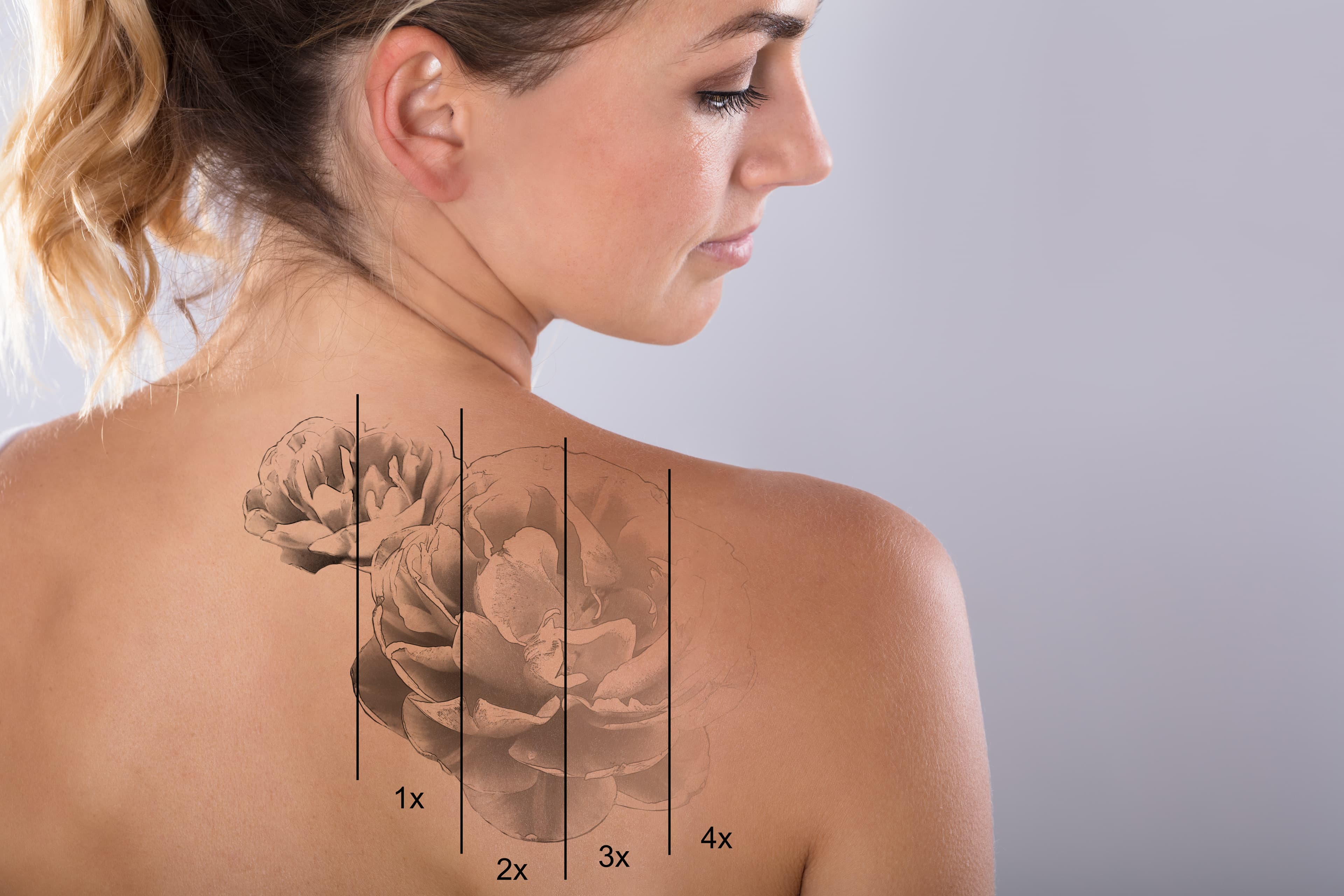
Complete tattoo removal is often possible, but it is not guaranteed for every tattoo. The honest answer sits between "yes, always" (which is overpromising) and "no, never" (which is wrong). What determines complete clearance versus leftover shadow is a combination of ink color, tattoo age, depth, skin type, and method choice. Understanding which of those apply to your tattoo is the difference between realistic expectations and disappointment. This page explains what complete removal actually looks like. It covers why fading and complete clearance are not the same goal. It covers which factors move the odds in your favor. And it covers when "near-complete" is the most honest outcome a provider can offer.
Can Tattoos Be Removed Completely?
Yes, many tattoos can be removed completely. Black ink tattoos have a realistic chance of full clearance when several conditions are met. The tattoo is average size and at normal depth. The skin is lighter. The laser is a modern picosecond or Q-switched Nd:YAG. And the provider is experienced.
The word "completely" is where honest and dishonest providers part ways. A clinic promising 100% removal in a fixed session count without examining your tattoo is overpromising. A provider who explains that complete removal is realistic but depends on specific factors, and gives you a range, is being honest.
The factors that increase the odds of complete removal:
- Black or dark blue ink
- Professional tattoo placed at standard depth (amateur tattoos often sit shallower and clear faster)
- Older tattoos (ink naturally fades over years, giving the laser less to break down)
- Smaller size
- Lighter skin tone, which allows higher fluence without thermal risk
- A picosecond laser or modern Q-switched Nd:YAG with appropriate wavelength
- Consistent session spacing and good aftercare
Conversely, colored tattoos, new work, saturated or layered work, very large pieces, darker skin tones, and ink placed near lymph nodes all make complete clearance harder.
Can Tattoos Be Fully Removed?
"Fully removed" usually means two things to patients. The first is clean skin with no visible trace of the tattoo. The second is no detectable pigment at all under close examination.
The first is achievable for most tattoos with the right treatment plan and enough sessions. The second is rarer. Trace particles can remain in the skin even after a tattoo appears visually gone. A careful dermatologist looking closely may still see faint shadow. That is not the same as the tattoo still being visible in normal conditions.
For the purposes of this page, "complete removal" means no visible trace of the tattoo at normal viewing distance under normal lighting. By that standard, yes, most tattoos can be fully removed. Some require more sessions than others. Some leave a faint ghost that only the patient can see. And some residual work sits at the edge of what any method can clear.
Does Tattoo Removal Completely Remove the Tattoo?
It depends on the tattoo and the treatment.
Laser tattoo removal, done well, can achieve complete visual clearance for most black and dark blue tattoos. It also clears many color tattoos with appropriate wavelength selection. Tattoos that typically clear fully include single-color black pieces, dark blue lettering, and faded older tattoos regardless of original color.
Tattoos that often leave residual pigment fall into a few categories. Bright colors (especially yellow, green, and white) resist clearance. Heavily saturated multi-color work leaves trace pigment. Recently done tattoos where ink is still fresh take longer. Tattoos with white highlighting are tricky because white ink can resist removal and sometimes darken. And cover-up tattoos can have multiple ink layers that compound the challenge.
Saline removal and other non-laser methods are better suited to PMU and small tattoos than to complete removal of large body tattoos. For body tattoo complete removal, laser is the standard.
Can Laser Remove a Tattoo Completely?
Yes, laser can remove many tattoos completely, especially black and dark blue ink on lighter skin. The practical limits are color, saturation, size, depth, and the laser used.
Here is what determines whether laser achieves full clearance:
- Ink color. Black absorbs most laser wavelengths well. Red, orange, yellow, green, blue, and white all respond differently. Some colors (yellow, green, white) are notoriously hard to clear and may leave trace pigment.
- Tattoo depth and saturation. Deep, saturated ink takes more sessions. Shallow amateur work clears faster, often with fewer sessions.
- Laser type. Picosecond lasers (PicoWay, PicoSure, Enlighten) generally achieve higher clearance rates than older Q-switched Nd:YAG, especially for stubborn colors and saturated work.
- Wavelength match. 1064 nm Nd:YAG for black, 532 nm KTP for red and orange, 755 nm Alexandrite for green and blue. A single-wavelength laser cannot optimally treat every color.
- Patient factors. Skin type, immune function, smoking status, and sun exposure all affect how effectively the body clears fragmented ink.
- Session count and spacing. Complete removal requires enough sessions with adequate spacing between them. Rushing sessions reduces clearance.
A provider claiming laser will completely remove any tattoo in any number of sessions regardless of these factors is not being honest.
How Many Sessions Does Complete Tattoo Removal Take?
Most black ink tattoos of moderate size and saturation require six to ten laser sessions for complete removal. Complex, colorful, or saturated tattoos often need ten to fifteen sessions. Some tattoos may need more.
Breakdown by type:
- Amateur black tattoos: often three to six sessions
- Professional black tattoos: typically six to ten sessions
- Multi-color professional tattoos: typically eight to fifteen sessions
- Heavily saturated or layered tattoos: can require fifteen or more sessions
- Cover-up tattoos: often need additional sessions compared to the original work
Sessions are usually spaced six to eight weeks apart for lighter skin, and eight to twelve weeks apart for darker skin. Total treatment timeline for complete removal is typically nine months to two years, sometimes longer for complex cases.
The Kirby-Desai scale is a clinical tool some providers use to estimate session count. It scores Fitzpatrick skin type, tattoo location, ink color, amount of ink, scarring, and layering to estimate how many sessions complete removal will require. Any provider who gives you a Kirby-Desai score is being methodical. A provider who promises a fixed session count without this kind of assessment is not.
Complete Color Tattoo Removal
Color ink is where complete removal gets harder. Different colors absorb different wavelengths, and not every laser covers every color optimally.
Black and dark blue are the easiest to clear completely. The 1064 nm Nd:YAG wavelength targets them well.
Red, orange, and yellow need a 532 nm wavelength. Yellow is particularly difficult and may not clear completely even with the right laser. Trace yellow is common in "completely removed" color tattoos.
Green and teal need a 755 nm Alexandrite or picosecond laser with 532 nm and 694 nm options. Green is another color that can leave residual pigment after multiple sessions.
White ink is the hardest and riskiest to remove. White pigment often contains titanium dioxide, which can oxidize and turn gray or black under laser. Many providers will not treat white ink at all, or will only treat it after a careful patch test.
Multi-color work requires multiple wavelengths over the course of treatment. A single-wavelength laser cannot achieve complete removal on a full-color tattoo. Complete removal for complex color work usually means treating with a multi-wavelength system or scheduling sessions on different lasers.
A provider treating a full-color tattoo with only one laser wavelength is likely to achieve fading but not complete clearance.
Complete Removal vs Fading
Fading and complete removal are not the same goal. Confusing them is one of the most common reasons patients feel disappointed with outcomes.
Fading means the tattoo is significantly lighter, often by 50-80%. It may still be visible as a shadow or ghost image. Fading is a legitimate end goal for cover-ups. It also fits patients who want reduced visibility without the time and cost of full removal. Three to five sessions is often enough for meaningful fading.
Complete removal means no visible trace of the tattoo at normal viewing distance. It requires more sessions, more time, and more money. Six to fifteen sessions is typical. A tattoo that is 80% faded is not 80% of the way to complete removal. The last 20% often takes disproportionately more sessions than the first 80%.
Deciding which goal fits matters. If you want a cover-up, fading is usually the better plan. If you never want the tattoo visible again, complete removal is the right frame from session one.
What Affects Complete Tattoo Removal Results?
Several factors move the odds of complete removal up or down.
- Ink color and saturation. Black and dark blue clear best. Yellow, green, and white are hardest. Heavily saturated work takes more sessions regardless of color.
- Tattoo age. Older tattoos have already undergone natural fading. Tattoos over five years old often clear in fewer sessions than fresh work.
- Professional vs amateur. Professional tattoos are deeper and more saturated but use consistent ink. Amateur tattoos often sit shallower but can contain unpredictable ink mixtures.
- Body location. Tattoos closer to the heart and lymph nodes clear faster. The lymphatic system drains ink particles more efficiently in those areas. Ankles, feet, wrists, and hands clear slower.
- Skin type. Lighter skin (Fitzpatrick I-III) allows higher laser fluence with lower thermal risk. Darker skin (IV-VI) requires more conservative settings and longer session spacing. It may also need more total sessions.
- Patient health. Immune function, smoking, hydration, sun exposure, and aftercare all affect how well the body clears ink between sessions.
- Method and provider. Picosecond lasers typically achieve higher clearance rates than Q-switched Nd:YAG. An experienced provider adjusts fluence, wavelength, and spacing by session. These adjustments are based on how the tattoo is responding.
Control what you can. Choose a good method and provider. Follow aftercare. Accept that the rest is biological.
Complete vs Near-Complete Outcomes
Near-complete is often the honest endpoint, and it is a legitimate outcome.
Some tattoos reach a point where additional sessions produce diminishing returns. The remaining pigment may be resistant ink. It may be deep particles the laser struggles to reach. Or it may be trace residual that only close examination reveals. At that point, additional sessions are expensive, carry risk, and may not produce visible change.
Most experienced providers will have a conversation around session eight, ten, or twelve. The question: is the remaining trace worth continuing to treat? Sometimes the honest answer is blunt: you are at 95% clearance, and the remaining 5% will not respond to more sessions. That conversation is a sign of a good provider, not a bad one.
Ghost images and shadowing occur when the outline of the tattoo remains faintly visible even after pigment is gone. This is usually textural, not pigment-based. Ghosting is usually a textural change rather than residual pigment. It can fade slowly over years. It is not true scarring and does not respond to further laser treatment.
If your goal was complete removal and you end up at 90-95% clearance, you still have a much less visible tattoo than you started with. That is a successful outcome, even if it does not meet the literal definition of "complete."
Color Tattoo Removal
Which colors are hardest to remove and what complete removal looks like by color.
Cover-Up Prep
How much fading you need before a cover-up, and what to expect.
Dark Skin Tattoo Removal
Wavelength choice and session spacing for Fitzpatrick IV-VI skin.
Best Tattoo Removal Method
Method comparison across use case, skin type, and completeness of removal.
- Laser Tattoo Removal. How picosecond and Q-switched lasers actually work.
- Non-Laser Tattoo Removal. Method category: saline, chemical extraction, dermabrasion-based.
- inkOUT vs Removery. Non-laser TEPR vs PicoWay across cities.
- Best Tattoo Removal Method. Method landscape: laser, non-laser, saline compared.
- Tattoo Removal in Austin. Provider landscape across the Austin metro.
- Tattoo Removal in Houston. Largest tracked market: chains, specialists, dermatology practices.
- Tattoo Removal in Tampa. Tampa Bay metro providers compared.